
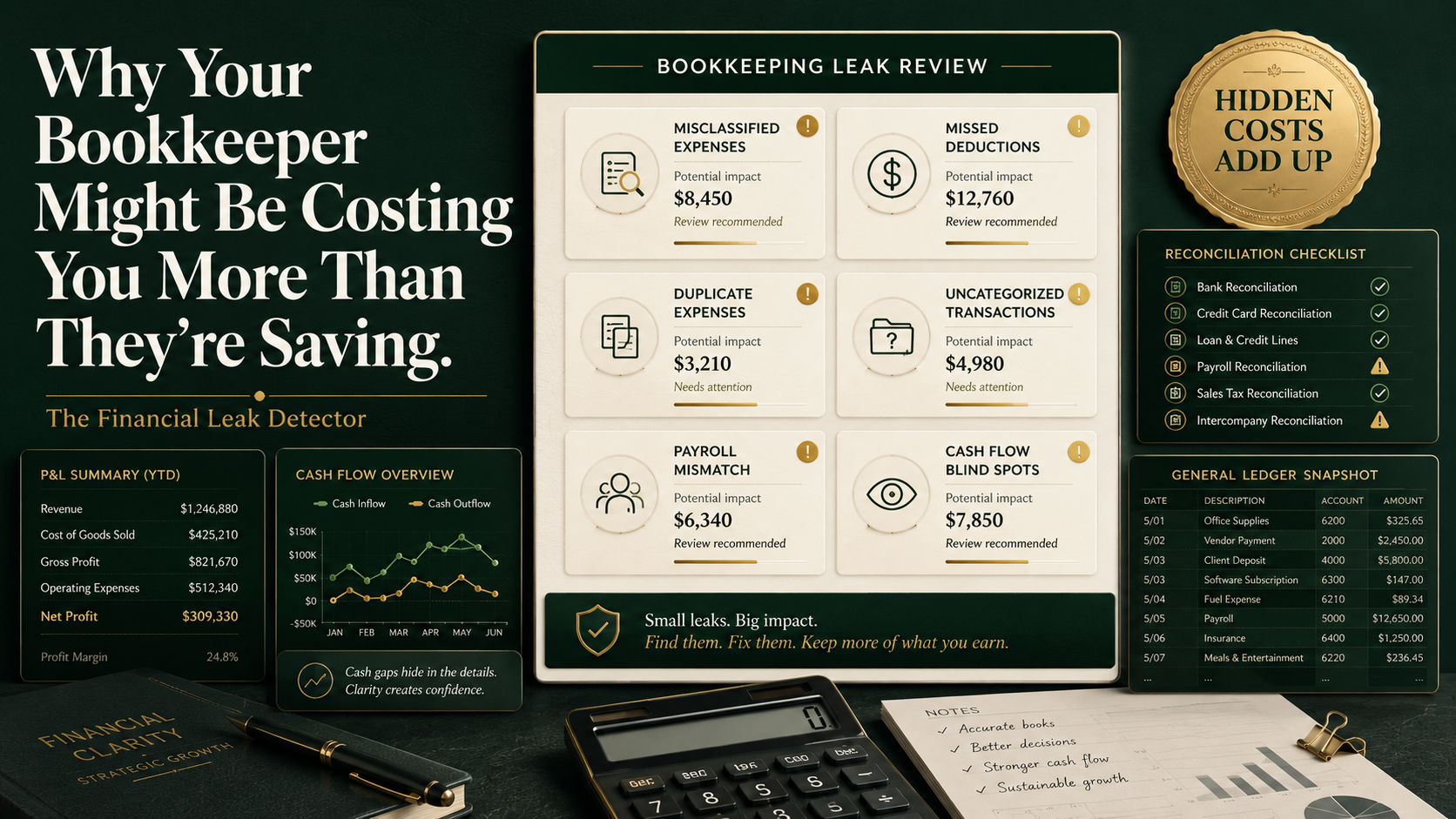
There's a quiet financial leak happening in thousands of small businesses across the country. It's not a missed deduction or a late filing penalty. It's the invisible cost of having the wrong financial function in your business.
That function is bookkeeping.
I've seen it firsthand: a $2M consulting firm paying a bookkeeper $45,000/year to reconcile accounts and generate financial statements—but never once being told that their average collection period for receivables was 67 days, or that their job costing data showed margin had dropped 8 points year-over-year.
The bookkeeper wasn't doing anything wrong. They were just doing the wrong job.
Bookkeeping vs. Financial Strategy: The Critical Distinction
A bookkeeper's primary function is to record what already happened. They categorize transactions, reconcile bank statements, ensure payroll is processed, and generate financial statements.
A CFO's primary function is to interpret what's happening and guide decisions about what should happen next. They analyze financial data, identify trends, model scenarios, and help you make better decisions about pricing, hiring, investment, and cash flow.
Most small businesses have a bookkeeper. Very few have a CFO. And the businesses that are growing fastest are the ones that figured out they needed both—or at least one person who can do both.
The Invisible Cost: What Bad Financial Visibility Actually Costs
Most business owners don't realize how expensive poor financial visibility is until they're in a cash crisis.
Here are the three most common costly situations we see when we take over financial visibility for a new client:
1. Mispriced contracts: Without accurate job costing or margin data, companies don't realize they're losing money on certain clients or project types until it's too late.
2. Cash flow surprises: Revenue looks healthy on paper, but the bank account is always tight. Usually this means slow collections, uneven billing cycles, or revenue recognition timing issues—none of which show up on a basic P&L.
3. Tax surprises: When bookkeeping is only done for compliance (once a year at tax time), you can't make tax-optimization decisions throughout the year. You're always behind, always reactive.
What Good Financial Infrastructure Looks Like
A business with strong financial infrastructure has three things happening simultaneously:
1. Clean, current books: Transactions are categorized weekly, at minimum. Bank statements are reconciled within days, not weeks.
2. Monthly financial review: A monthly meeting (even 30 minutes) where someone walks through the numbers—not just the revenue and profit, but the key metrics that drive business health: gross margins, collections, cash runway, and pipeline.
3. Proactive tax visibility: Estimated tax payments are calculated and set aside throughout the year, not discovered in a panic every quarter.
How to Find Out If Your Bookkeeper Is Costing You More Than They're Saving
Ask them these three questions and watch how they respond:
"What was my true gross margin last month and how does that compare to last year?" If they can't answer quickly, the books aren't being analyzed — just maintained.
"What is my current cash runway — how many months of expenses do I have in the bank?" If they don't know, they're not tracking cash position in real time.
"What should I be setting aside for taxes right now?" If they don't have an answer, tax planning isn't part of their scope.
If you got silence or vague answers to all three, you have a bookkeeper, not a financial partner. And that silence is costing you.
The Fix: Either hire a CFO function (fractional or full-time) or insist your current bookkeeper evolve into one. If they can't or won't provide monthly analysis and forward-looking financial guidance, it's time to find someone who will.