
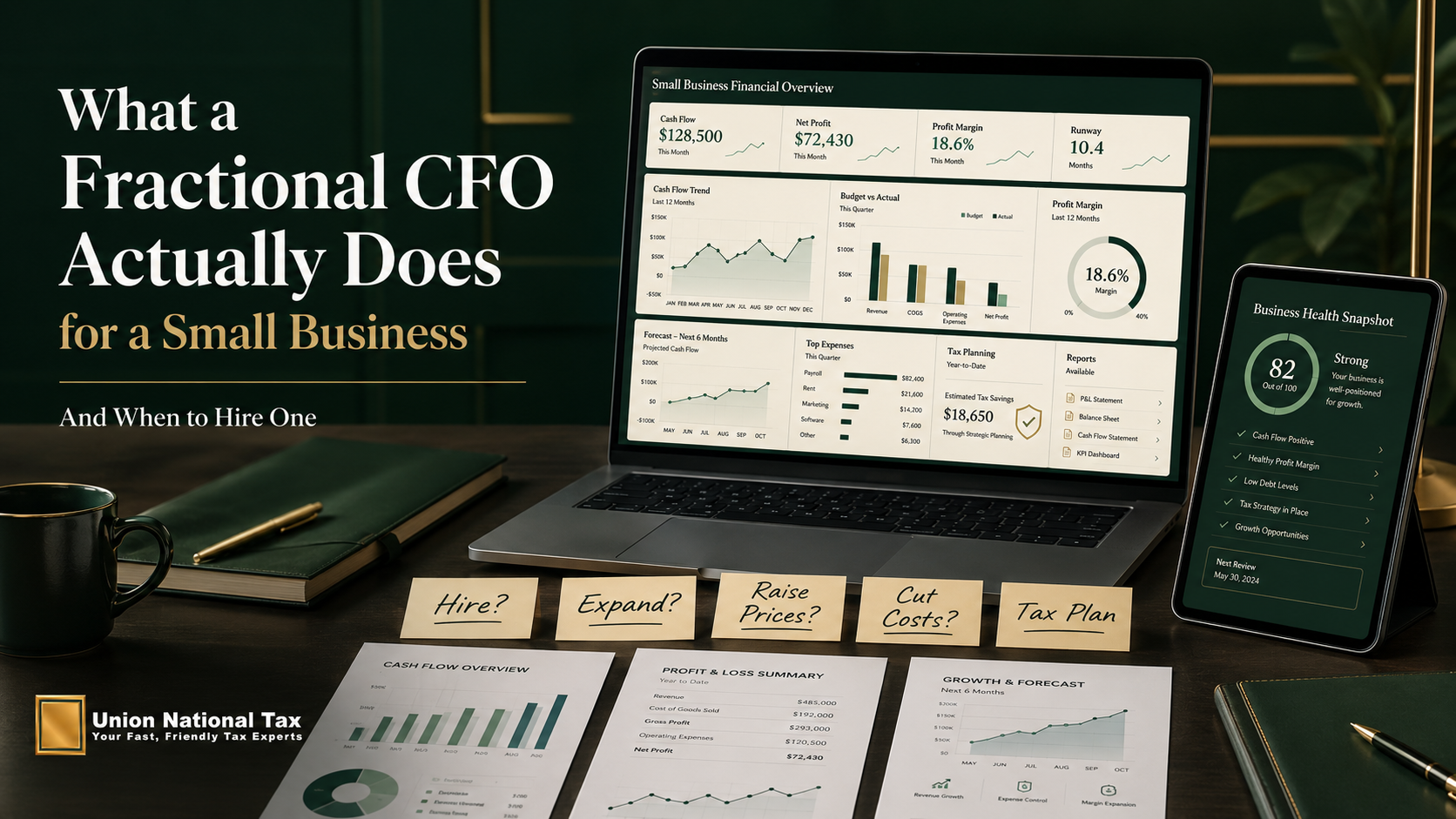
Your bookkeeper gives you numbers. A CFO helps you decide what to do with them.
That distinction is the whole thing. If you've been running your business on a P&L you barely understand, with no real financial model, no forecasting, and no one asking "what's the plan for that cash?" — you don't need a better bookkeeper. You need a CFO.
What "Fractional CFO" Actually Means
Fractional CFO is a practical term for a senior financial operator who works with your business on a part-time or project basis — without the cost of a full-time executive.
It's not:
- A part-time employee. You get strategic depth, not a junior seat-filler.
- A CPA or tax preparer. CPAs file returns. We make decisions.
- A business consultant with generic advice. We work inside your numbers.
A fractional CFO is a financial operator who has seen dozens of businesses at your stage, knows what decisions actually move the needle, and is in your corner building the financial architecture of your company.
What a Fractional CFO Actually Does (Day-to-Day)
Forget job descriptions. Here's what it looks like when it's working:
Cash flow forecasting. Not a spreadsheet you update once a quarter — a living model that tells you: "If we hit this revenue number, here's what hits your bank account. If it slips, here's when you need to cut burn." You stop being surprised by your own cash position.
KPI tracking that matters. We identify the 5–7 numbers in your business that actually tell you if you're winning or losing — not vanity metrics, not gut feelings. Revenue is not a KPI. Margin is. Days sales outstanding is. Customer acquisition cost vs. lifetime value is.
Pricing decisions. You want to raise prices? We'll model the customer loss rate, the margin improvement, and tell you the exact price point where you're better off even if you lose 20% of customers. Usually it's higher than you think.
Financial model for growth. When you want to hire, open a second location, buy equipment, or take on a major contract — we build the model that shows whether it works before you sign anything.
Tax strategy alignment. A CFO and a tax strategist working together means financial decisions and tax decisions get made at the same time. Not after the fact. Not in April.
Who This Is Right For
A fractional CFO engagement makes sense when:
- You're doing $500K+ in revenue and flying blind. You know you're profitable. You can't explain why cash is tight. You have no idea what your real margins are by service line or product.
- You're preparing for a loan or investor conversation. And you need someone to build the financial model, the projections, and the story — not just clean up the numbers.
- You're making major decisions without financial visibility. You signed a lease. You hired someone. You bought equipment. And you did it on a feeling, not a model.
- Your bookkeeper is great but you keep outgrowing them. They keep the books clean. They can't tell you what to do with the data.
If any of those landed, it's worth a conversation.
What It Costs and What ROI to Expect
Be direct: fractional CFO work isn't cheap. You're paying for strategic depth, not data entry.
Ranges vary by scope and complexity, but here's the honest frame: most small business engagements that move the needle deliver ROI within 60–90 days of the first major decision made with better financial clarity.
Examples:
- A pricing decision that adds 3–5 points of margin on $800K revenue = $24,000–$40,000 in additional profit
- A cash flow model that prevents a credit line draw at 12% interest during a slow quarter
- A tax strategy alignment that shifts $50K of income into a lower-tax quarter via timing
The first decision your CFO helps you make — if it's a real decision, not a theory — should pay for the engagement.
Let's Talk About What This Looks Like for Your Business
[Schedule a Conversation with Jason at Union National Tax]
We'll talk about where your business is, what's actually happening with your numbers, and whether a fractional CFO engagement makes sense for you right now. If it doesn't, we'll tell you that too.