
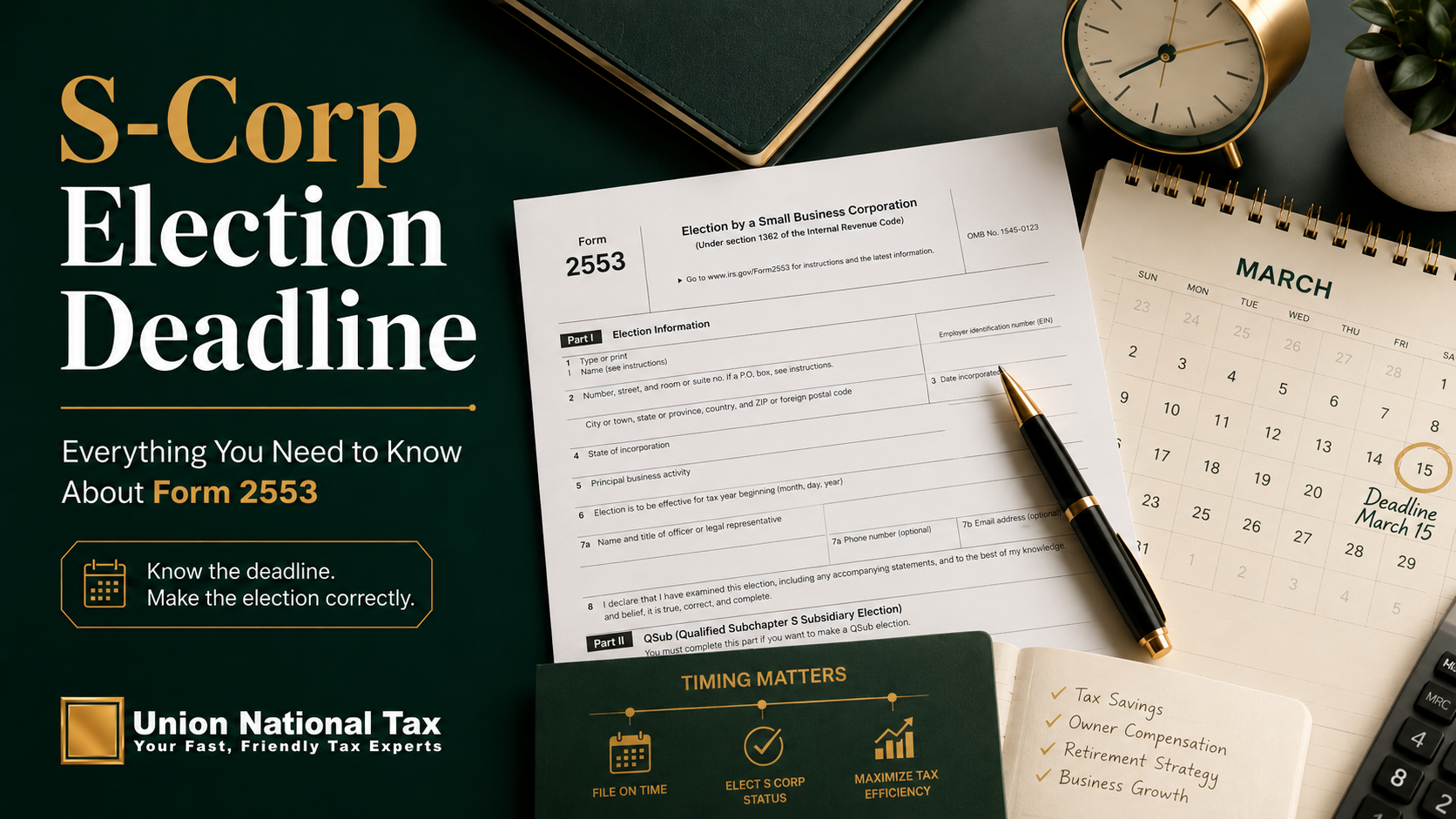
Filing Form 2553 is how you elect S-Corp status, unlocking significant tax savings on self-employment taxes. But the deadlines are strict, the rules are nuanced, and the consequences of missing them are costly. Here's exactly what you need to know to make the election correctly and on time.
Form 2553, "Election by a Small Business Corporation," is the document you file with the IRS to elect S-Corp status. The form must be signed by all shareholders who owned stock during the tax year, and it must be filed properly to be valid.
The standard deadline for filing Form 2553 is the 15th day of the 3rd month of the tax year (March 15 for calendar-year taxpayers). For a new business or an election taking effect in the current year, this deadline must be met exactly. If you're reading this in February and want S-Corp status for this tax year, you still have time. But the deadline approaches quickly.
But what if you've missed the deadline? There are two pathways to a late election relief. First, the IRS sometimes accepts late elections if you file Form 2553 and attach a reasonable explanation for the lateness and demonstrate reasonable cause. This approach is uncertain and often denied.
Second, you can make a "relief" election by filing Form 2553 within six months of the due date (September 15 for calendar-year taxpayers) with a cover letter requesting automatic late election relief. The IRS generally grants this relief automatically if the election is made within this extended window and the corporation was eligible for S-Corp status from the beginning.
For elections intended to take effect in a prior year (e.g., you realized in April that you should have elected S-Corp status for last year), the late election relief is more complicated. You'd need to file Form 2553 with a detailed explanation and likely request IRS consent for the retroactive election. This is possible but requires strong justification.
The form itself is relatively straightforward. Part I requires basic information about the corporation—name, address, EIN, state of incorporation, and the tax year for which the election is being made. Part II requires shareholder information, including each shareholder's name, social security number, number of shares owned, and ownership percentage. Part III is the election statement, where all shareholders sign acknowledging the election.
One common mistake is not getting all shareholders to sign. Every shareholder who owned stock during the election year must sign the form. If there are multiple shareholders, this can be a coordination challenge. Missing even one signature can invalidate the election.
Another common mistake is using the wrong tax year. The form requires specifying whether you're electing for a calendar year or fiscal year, and the fiscal year must be a valid S-Corp fiscal year (one that satisfies the "majority test" or "26-week test" for how closely it follows the calendar year).
After filing, you should receive a confirmation from the IRS. Keep this confirmation with your corporate records. If you don't receive confirmation within a few months, follow up with the IRS to ensure the election was processed correctly.
Once your S-Corp election is in place, you're committed for that tax year and generally for future years (there are ways to terminate the election, but they require specific events or IRS consent). So plan carefully before making the election.
What happens if you file on time but the IRS rejects your election? Sometimes the IRS will reject Form 2553 due to technical issues—missing information, wrong format, unclear answers. If this happens, you typically have 60 days to correct and refile. Keep copies of everything you send and consider using certified mail for proof of timely filing.
Working with a tax professional is strongly recommended for S-Corp elections. They can ensure the form is completed correctly, all shareholders sign, the timing is optimal, and any elections within the form (like the qualified business income deduction under Section 199A) are handled properly. The cost of professional preparation is trivial compared to the risk of a rejected or ineffective election.