
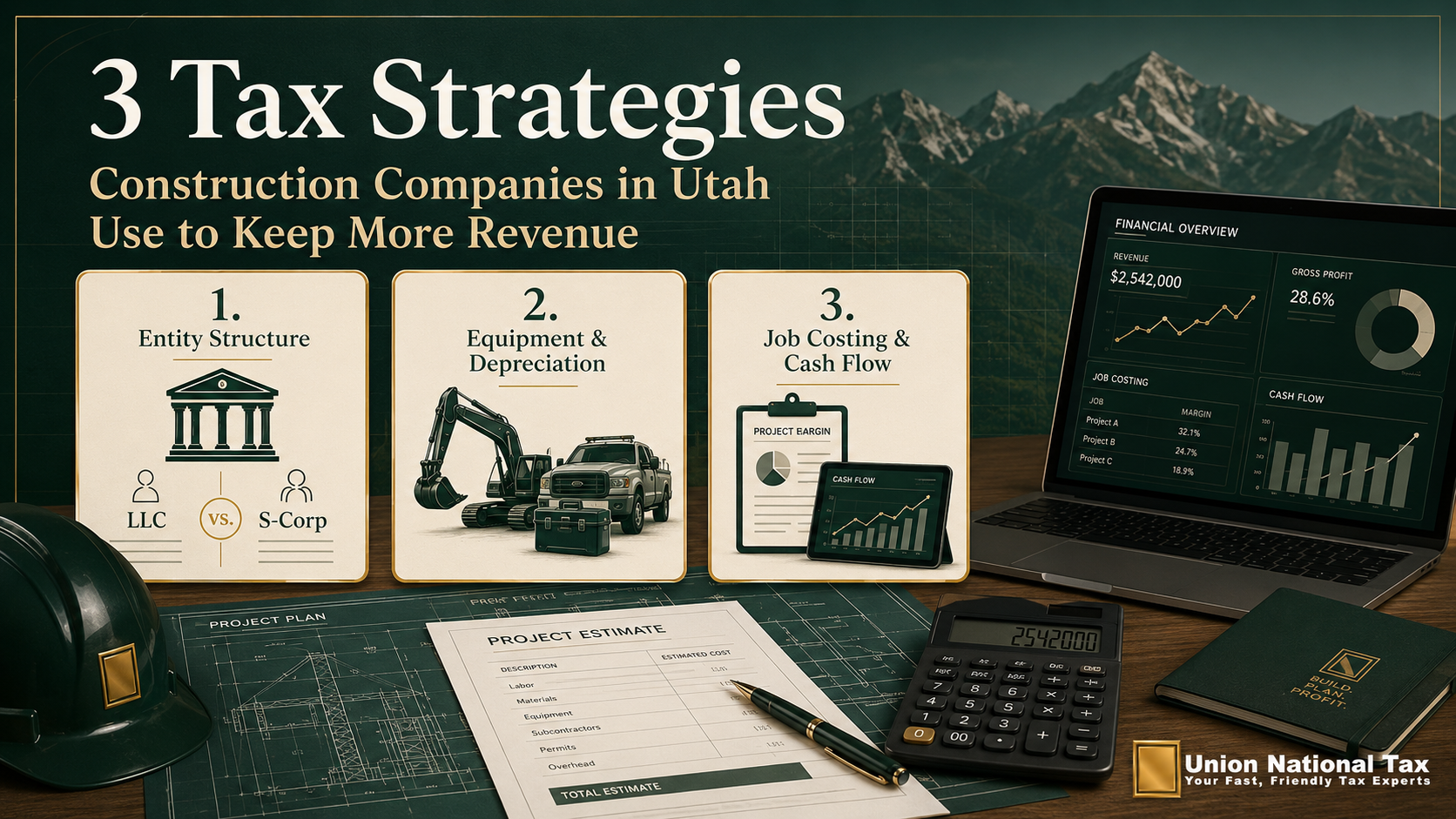
Making money in construction is hard. Keeping more of it shouldn't require a second job.
If you're a general contractor, a GC, a real estate investor, or a trade contractor running a crew in Utah — you already know how to make a job work. The question is whether your tax strategy is working as hard as you are.
Here are three strategies that construction companies in Utah consistently leave on the table.
Strategy 1: Qualified Business Income (QBI) Deduction Optimization
The Tax Cuts and Jobs Act created a 20% deduction for pass-through businesses — known as the Qualified Business Income (QBI) deduction. For construction companies structured as S-Corps, LLCs, or partnerships, this is real money.
The math: On $300,000 of taxable business income, the QBI deduction can be worth $60,000 — off your taxable income, not just your tax liability.
But here's where contractors lose it: the deduction has limitations for "specified service trades or businesses." Once your taxable income exceeds certain thresholds, the deduction phases out for businesses in construction, real estate, and related fields.
What most people miss: Proper entity structuring and income planning can preserve or expand your access to the QBI deduction. It's not about one tax year in isolation — it's about how your compensation strategy and distribution planning affect your taxable income threshold.
We're not talking about dodging anything. We're talking about legal structuring that keeps the deduction available to you.
Strategy 2: Vehicle and Equipment Depreciation — The Timing Game
Construction businesses are asset-heavy. Trucks, trailers, excavators, tools, equipment. Most contractors know Section 179 lets you deduct the full purchase price of equipment in the year it's placed in service instead of depreciating it over time.
Most contractors don't plan around it.
Here's what "not planning" costs you:
You buy a new truck in November for $55,000. If you don't have a depreciation strategy in place, you might miss the window to expense it in the current year — or worse, you don't know you could have accelerated a purchase you were going to make anyway and moved the deduction forward.
Bonus depreciation is another tool. Congress has made significant bonus depreciation available in recent years, and the rules have been shifting. If nobody on your tax team is monitoring the current bonus depreciation percentages and how they interact with Section 179, you're leaving real deductions on the table.
The decision: Should you buy equipment before year-end? Should you accelerate a planned purchase? Those are not January questions. They're Q3 and Q4 questions.
Strategy 3: Year-End Tax Planning vs. Year-Round Tax Engineering
Most contractors do tax planning once a year — usually in November or December, when there's not much left to do. They get a number. They panic. They ask, "What do we do now?"
The answer: usually not much. The levers that could have been pulled are already past.
Proactive tax engineering means:
- Quarterly reviews of income, expenses, and cash position
- Timing elections made before the window closes, not after
- Equipment purchase planning aligned to your tax situation, not just your job needs
- Compensation strategy set before year-end — salary vs. distribution decisions, retirement plan contributions, health insurance deductions
- Entity analysis run annually to confirm the structure still makes sense
For construction companies in Utah, Q4 close is also when you're busiest — which is exactly why it's the worst time to be making tax decisions reactively.
These Strategies Work — But Only If Someone's Running Them
You're good at building things. That's your job. Tax strategy is ours.
[Schedule a Tax Strategy Session with Union National Tax]
If you're a Utah contractor or construction company owner and you're tired of getting a tax bill instead of a tax plan, let's talk before Q4 closes. The decisions that affect your 2026 tax year are being made right now — whether you realize it or not.