
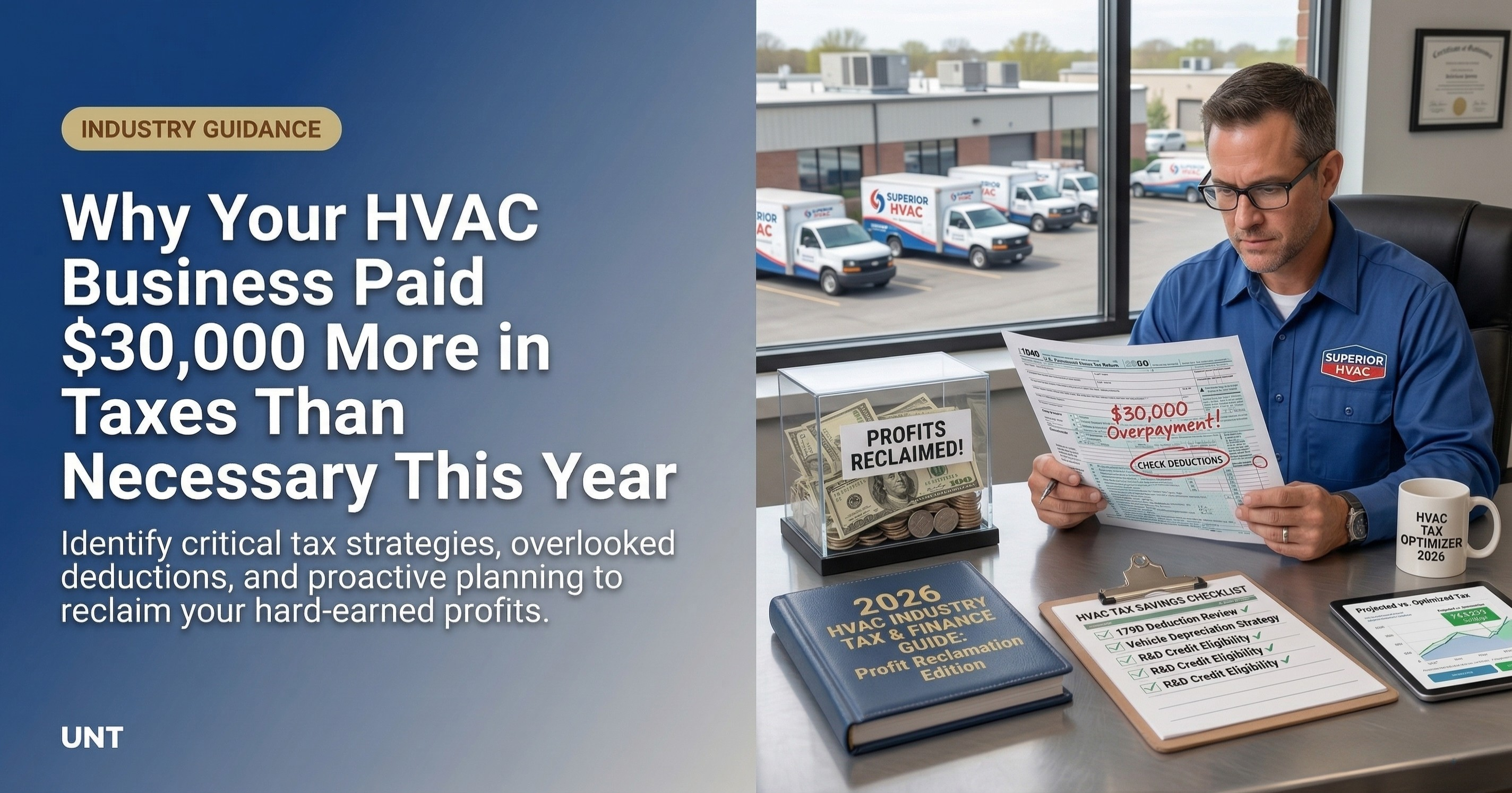
You made money. Good. So why does it feel like the IRS made more?
If you're an HVAC contractor pulling in $150K, $200K, $250K a year and watching a massive tax bill hit every April, you're not alone. You're also not helpless.
The problem isn't that you didn't work hard enough. The problem is that most contractors are running their business through the wrong entity structure — and leaving tens of thousands on the table every single year.
The Hidden Tax Drain You Probably Don't Know About
Here's the part your last tax preparer probably didn't explain clearly: self-employment tax.
When you're a sole proprietor or single-member LLC, every dollar of net profit gets hit with 15.3% self-employment tax — before income tax even enters the picture.
Let's run the math on a $200,000 net profit year:
- $200,000 net profit
- × 15.3% self-employment tax = $30,600
- That's on top of your income tax
You didn't mess up. You didn't cheat. You just didn't know there's a legal way to split that profit — so only the portion you call "salary" gets hit with self-employment tax.
The Entity Problem (And the Legal Fix)
Here's what's actually happening.
Most contractors operate as LLCs or sole proprietors. The IRS treats all of that profit as self-employment income. There's no separation. No strategy. Just one big pile, taxed heavily.
An S-Corp election changes the rules.
With an S-Corp, you pay yourself a reasonable salary — say $60,000 — and take the remaining $140,000 as distributions. Only the $60,000 salary is subject to self-employment tax.
The math on that same $200,000:
- Salary portion: $60,000 × 15.3% = $9,180
- Distribution portion: $140,000 × 0% SE tax
- Your self-employment tax drops from $30,600 to $9,180
- That's $21,420 back in your pocket
That's not a loophole. That's the law. It's been there for decades.
Reactive Filing vs. Proactive Tax Engineering
Most accountants do one thing: they prepare your return. They take what happened, plug it into a form, and tell you what you owe.
That's reactive. And it costs you every year.
Proactive tax strategy means we look at your business in January — before the year starts — and engineer your tax situation. We decide how to structure income, when to take distributions, whether to accelerate expenses, and what equipment purchases make sense before Q4.
By the time April rolls around, the tax bill is already optimized. We didn't scramble. We built it that way from the start.
See If You Left Money on the Table This Year
If you're a contractor earning over $80K net and you've never had an S-Corp analysis done, there's a real chance you overpaid.
It takes 90 seconds to run the numbers.
[Run the S-Corp Calculator →]
If the numbers work, we'll tell you. And if they don't, we'll tell you that too. No fluff. Just your actual tax situation, clearly.