
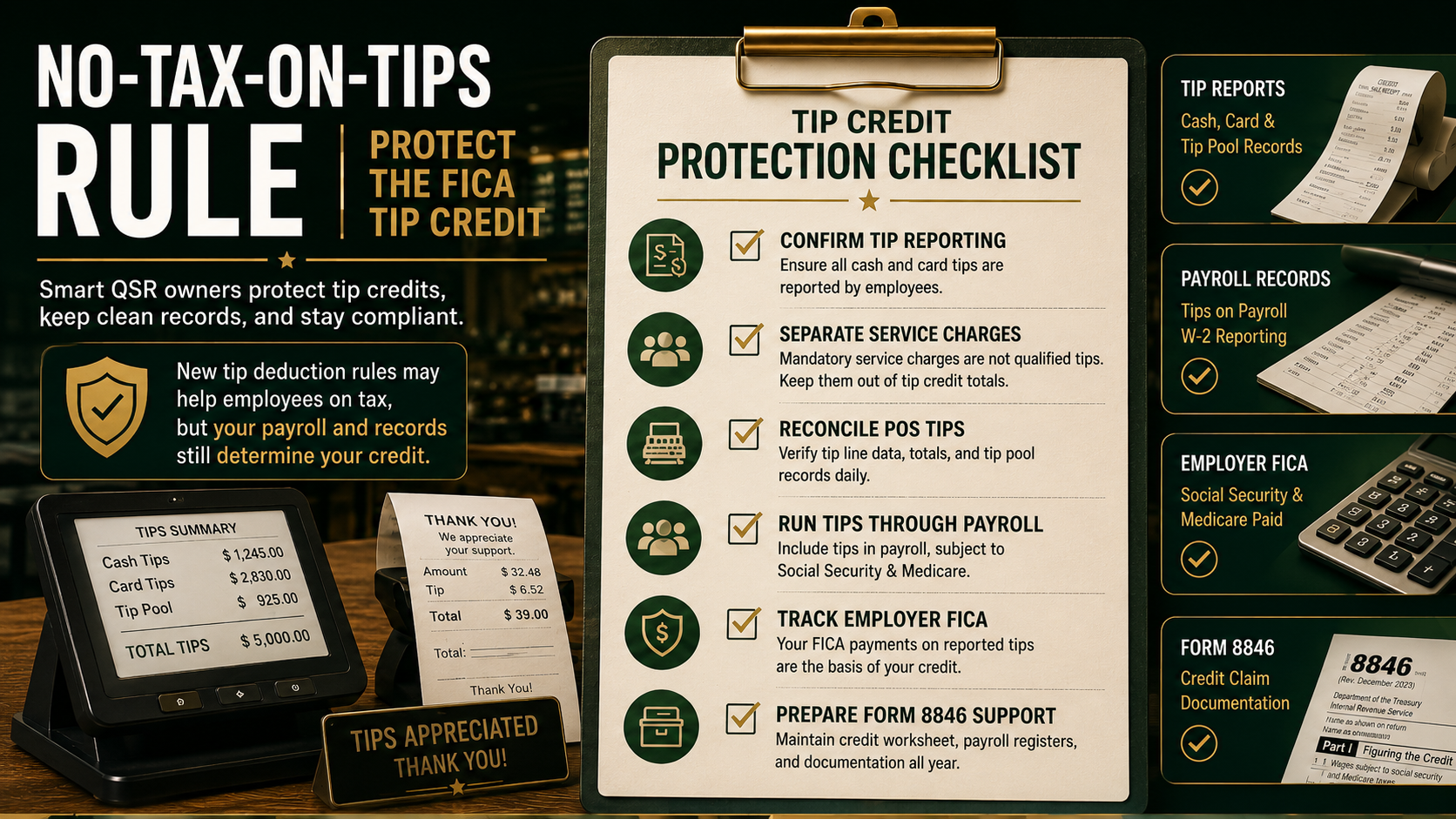
On July 4, 2025, the One Big Beautiful Bill Act (OBBBA) was signed into law — and buried inside it was a provision that every restaurant and QSR operator in America needs to fully understand before their next payroll run.
The headline is simple: employees in tipped occupations can now deduct up to $25,000 of qualified tip income from federal taxable income, effective for tax years 2025 through 2028. For your staff, that's a meaningful tax break. For you as the employer, it creates a new set of compliance obligations — and a real risk of losing a credit worth thousands of dollars per year if you don't act now.
This guide explains exactly how the no-tax-on-tips rule works, what it means for your payroll, how it interacts with the FICA Tip Credit you may already be claiming, and the specific steps you need to take to stay compliant and protected.
⚠️ Disclaimer: This article is for informational purposes only and does not constitute tax or legal advice. Consult a licensed tax professional for guidance specific to your business.
What the No-Tax-on-Tips Rule Actually Does
Despite the name, "no tax on tips" is not a complete elimination of taxes on tip income. It's a new above-the-line federal income tax deduction — not an exemption from payroll taxes. Here's the precise breakdown of what changed and what didn't:
- What changed: Employees in qualifying tipped occupations can deduct up to $25,000 of qualified tip income when filing their federal income tax return. This directly reduces their federal taxable income.
- What did NOT change: Tips are still fully subject to FICA taxes (Social Security and Medicare — 7.65% employee, 7.65% employer). Employees still must report all tips to you as the employer. You still withhold FICA on those tips every payroll cycle.
- Who qualifies: Only employees in occupations that "customarily and regularly" received tips on or before December 31, 2024 — servers, bartenders, bussers, valets, hairstylists, and others on the IRS Treasury Tipped Occupation list. Each qualifying occupation has been assigned a Treasury Tipped Occupation Code (TTOC).
- Income cap: The deduction phases out for employees with Modified Adjusted Gross Income (MAGI) above $150,000 for single filers. Tips above $25,000 remain fully taxable. Married employees must file jointly to claim the deduction.
- Voluntary tips only: Mandatory service charges, automatic gratuities for large parties, and any negotiated fee do not qualify — even if your staff receives them. Only tips that are fully voluntary and determined by the customer qualify.
- Effective dates: Tax years 2025 through 2028. This is a temporary provision — not permanent law.
The W-2 Reporting Changes You Cannot Ignore
Here is where most QSR operators are getting caught flat-footed. The OBBBA didn't just change tax treatment for employees — it changed what you are required to report on their W-2s starting with the 2026 tax year. If your payroll system isn't already updated, you are behind.
Beginning with 2026 W-2s, employers must:
- Report qualified tips in Box 12, Code TP. This is a new code. Qualified voluntary tip amounts must be reported here separately from regular wage income so employees can claim their deduction at filing time.
- Report Treasury Tipped Occupation Codes (TTOC) in Box 14b. You must identify which Treasury occupation code applies to each tipped employee on your payroll. This is a new employer-side requirement that requires matching your job titles to the IRS Treasury list.
- Separate voluntary tips from service charges in payroll records. If your POS system or payroll processor currently lumps tips and auto-gratuities together, that must change now. They are now legally distinct categories for tax reporting purposes.
The IRS announced penalty relief for 2025 W-2s (filed in early 2026) while the proposed regulations were being finalized. That relief does not extend to 2026 W-2s. The new Box 12 Code TP and TTOC reporting requirements are mandatory for the 2026 tax year — filed in early 2027. Get your payroll and POS systems updated now, not next December.
What This Means for the FICA Tip Credit
If you're operating a food and beverage business with tipped employees and you're not currently claiming the FICA Tip Credit (Form 8846), stop reading this sentence and call your tax professional today. This is one of the most underutilized tax credits in the restaurant industry — and the new no-tax-on-tips rule makes it more important, not less.
What Is the FICA Tip Credit?
The FICA Tip Credit is a dollar-for-dollar federal tax credit that allows restaurant employers to recover 7.65% of the FICA taxes they pay on employee tips that exceed the federal minimum wage ($7.25/hour). Since tips are treated as wages for FICA purposes and you pay the employer's 7.65% share on all reported tip income, the IRS created this credit specifically to offset that cost — and to incentivize restaurants to encourage full tip reporting.
The credit is calculated as:
FICA Tip Credit = 7.65% × (Total reported tips − Tips used to bring wages to $5.15/hour)
It is claimed on Form 8846, which flows through to Form 3800 (General Business Credit) on your business tax return. Unused credit can be carried back one year or forward 20 years. For a mid-size QSR with $200,000 in annual reported tip income, this credit alone can be worth $10,000–$15,000 per year.
How the OBBBA Creates New Risk for Your FICA Tip Credit
Here's the critical connection most QSR operators are missing: the FICA Tip Credit is only available on properly reported, properly classified tips. The new no-tax-on-tips law requires you to separately track and report voluntary tips versus mandatory service charges. If those two categories are mixed together in your payroll or POS system — as they are in many restaurants — your FICA Tip Credit calculation will be wrong, and the IRS will have grounds to challenge it.
Specifically, you are at risk if:
- Your POS system combines cash tips, credit card tips, and auto-gratuities into a single "tip" category
- Your payroll processor reports all tip-like income under the same payroll code without separating voluntary from mandatory
- You have employees in non-qualifying occupations receiving tips through pooling — and those are being reported as qualified tip income
- You are adding large-party service charges as gratuities on your POS but not reclassifying them as wage income in payroll
Each of these scenarios was a gray area before the OBBBA. In 2026, they are compliance failures with real financial consequences.
The 5 Actions QSR Owners Must Take Right Now
1. Audit Your POS Tip Classification System
Log into your POS system today and identify every payment type that currently flows into a "tip" category. Separate voluntary customer tips from automatic gratuities and mandatory service charges. These must be coded differently at the POS level, processed differently in payroll, and reported differently on W-2s. If your POS doesn't support this separation natively, contact your provider for a configuration update or workaround.
2. Update Your Payroll System for Box 12 Code TP and TTOC
Contact your payroll provider — whether that's Gusto, ADP, Paychex, or a local processor — and confirm they are configured to report qualified tips in Box 12 Code TP and to accept Treasury Tipped Occupation Codes in Box 14b for the 2026 tax year. If they are not yet updated, escalate the issue in writing and document your request. You are legally responsible for correct W-2 reporting regardless of whether your payroll provider is ready.
3. Map Every Tipped Employee to a Treasury Occupation Code
The IRS NPRM published in September 2025 includes the full list of qualifying occupations and their assigned Treasury Tipped Occupation Codes (TTOCs). Review your entire front-of-house roster — servers, bartenders, bussers, food runners, counter staff — and match each job title to the appropriate TTOC. Back-of-house employees who receive tips through tip pooling but whose occupation is not on the qualifying list do not generate qualified tips for Box 12 Code TP purposes.
4. Eliminate Automatic Gratuities on Customer Receipts — or Reclassify Them
If you currently add automatic gratuities for large parties and route them through payroll as tips, you have two options: eliminate them entirely and allow customers to tip voluntarily, or keep them as mandatory service charges but ensure they are classified as regular wage income — not tips — in your payroll system and on W-2s. Reporting a mandatory service charge as a "qualified tip" is a misclassification that creates exposure on both your FICA Tip Credit and your employees' deductions.
5. Start Claiming the FICA Tip Credit If You Aren't Already
If you have tipped employees and you are not filing Form 8846 with your business tax return, you are leaving a significant dollar-for-dollar credit unclaimed. Pull your reported tip income from the last three years, calculate the credit you should have claimed, and speak with your tax professional about filing amended returns to recover it. Going forward, ensure Form 8846 is part of your annual tax return preparation process — and that the credit is being calculated on properly classified voluntary tips only.
A Quick-Reference: Tips vs. Service Charges in 2026
Factor
Qualified Tip
Mandatory Service Charge
Determined by
Customer, voluntarily
Employer, mandatory
Negotiable?
No — freely given
Yes — set by policy
Subject to federal income tax
No (up to $25,000 deduction)
Yes — fully taxable
Subject to FICA taxes
Yes
Yes
Generates FICA Tip Credit
Yes (if above $5.15/hr threshold)
No
W-2 reporting
Box 12 Code TP + TTOC in Box 14b
Box 1 wages — no special code
Examples
Credit card tips, cash tips, tip pool distributions from voluntary tips
Auto-gratuity (18%), banquet service fees, delivery surcharges paid to staff
Don't Let Compliance Cost You More Than the Tax Break Saves Your Staff
The no-tax-on-tips rule is genuinely good news for your employees — and a powerful recruiting and retention tool at a time when labor competition in the QSR industry is fierce. But the employer-side compliance requirements that come with it are real, and the operators who ignore them face a double exposure: IRS penalties for incorrect W-2 reporting and loss of the FICA Tip Credit they were already entitled to claim.
At [Your Firm Name], we specialize in tax compliance and financial strategy for restaurant and QSR operators. We'll audit your current tip reporting setup, map your employees to the correct Treasury occupation codes, ensure your FICA Tip Credit is being fully captured, and get your payroll aligned with the 2026 W-2 requirements before the deadline hits.
👉 Book a Free Restaurant Tax Compliance Review — Let's make sure the new law works for your business, not against it.
Sources: One Big Beautiful Bill Act (OBBBA), signed July 4, 2025; IRS Notice of Proposed Rulemaking on No Tax on Tips, September 2025; IRS Form 8846 Instructions 2026; Jackson Lewis OBBBA Employer Alert, January 2026; Netchex 2026 Payroll Compliance Guide.