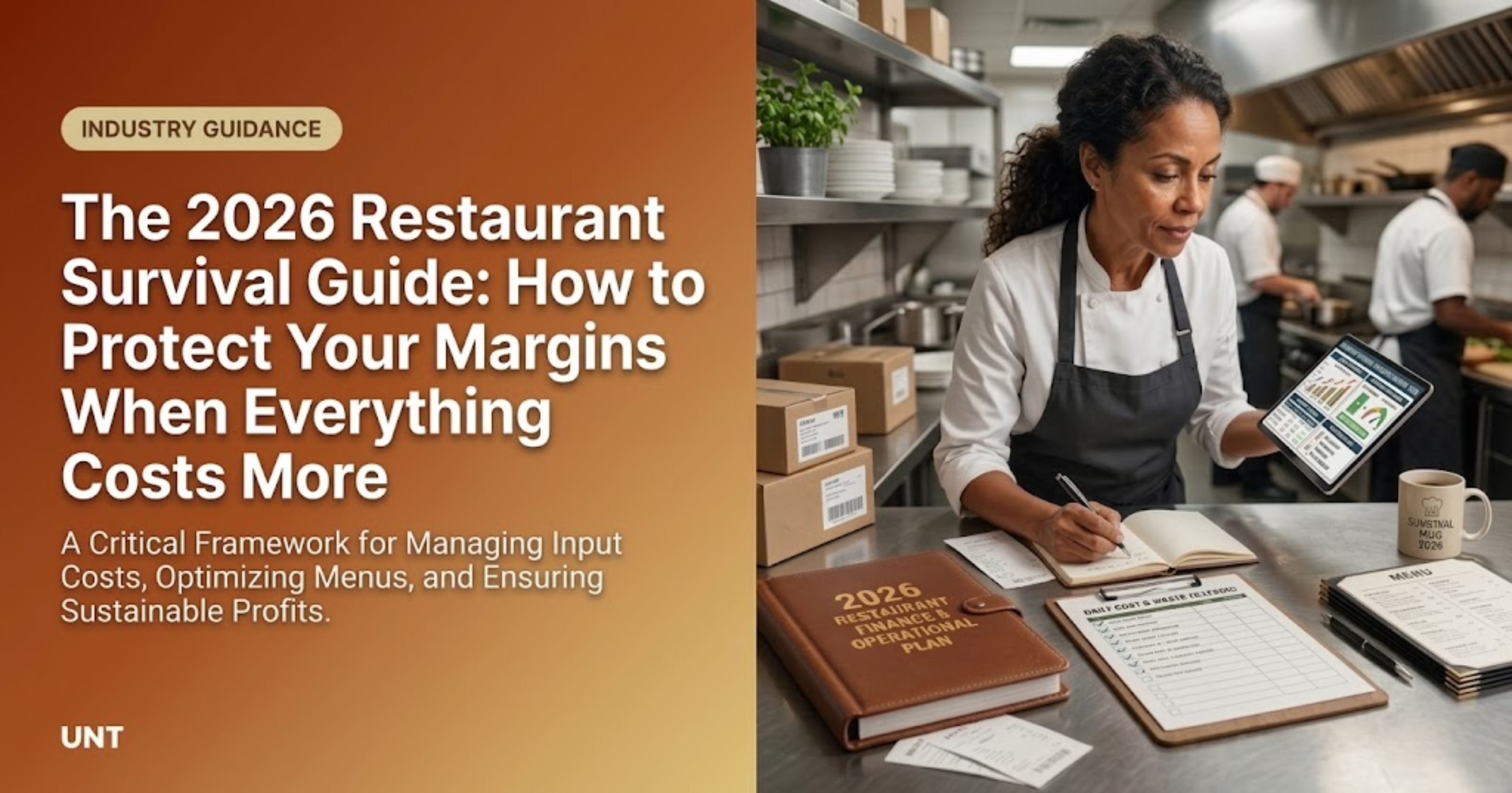
The 2026 Restaurant Survival Guide: How to Protect Your Margins When Everything Costs More
J
Jason AstwoodFounder & Lead Tax Strategist
April 01, 2026
7 min read
Let's be honest: 2026 is not a forgiving year to run a restaurant.
Food costs are more than 35% above pre-pandemic levels. Labor costs have risen nearly 10% since 2020. Food-away-from-home prices are expected to climb another 3.3% this year — and 42% of restaurant operators reported their business was not profitable last year. At the same time, diners are scrutinizing every dollar they spend, and foot traffic growth has plateaued.
The operators surviving — and some of them genuinely thriving — aren't doing it by luck. They're running their businesses with tighter systems, smarter menus, leaner operations, and a clear-eyed look at where margin is bleeding out. This guide breaks down exactly how to do the same.
⚠️ Note: The statistics in this guide are sourced from the National Restaurant Association's 2026 State of the Industry Report, USDA Food Price Outlook, and Bureau of Labor Statistics data. Every restaurant is different — use these strategies as a starting framework and adapt them to your specific operation.
The Real Numbers: What You're Up Against
Before you can fix a margin problem, you need to understand exactly what's squeezing it. In 2026, the pressure is coming from five directions simultaneously:
Food & beverage costs — Up 35%+ from pre-pandemic levels. Expected to rise another 3.3% in 2026.
Labor costs — QSR labor now averages 25% of revenue. Full-service climbs to 36.5%. Both are trending up, with 89% of operators expecting continued wage increases.
Insurance & energy — More than 9 in 10 operators cite these as significant cost challenges alongside food and labor.
Delivery platform fees — Delivery now costs diners nearly 80% more than pickup, driving a 12% drop in delivery orders and a 14% increase in pickup — squeezing operator margins on third-party orders.
Softer traffic — Real sales growth is forecast at just 1.3% in 2026. Operators can't volume their way out of a margin problem this year.
Food and labor together account for 70% of a restaurant's total expenses. That's where the focus has to be — and that's exactly what this guide addresses.
Strategy 1: Engineer Your Menu for Profit, Not Just Variety
Most restaurant owners built their menu around what they love to cook or what customers have historically ordered. In 2026, that approach is quietly killing margins. Menu engineering — the practice of analyzing each item's profitability against its popularity — is one of the highest-leverage moves an operator can make without spending a dollar on marketing.
The framework is simple. Every item on your menu falls into one of four categories:
Stars — High profit, high popularity. Feature these prominently, protect the recipe, upsell them actively. These are your business.
Plowhorses — Low profit, high popularity. Customers love them but they're costing you. Slightly raise the price, reduce portion size, or simplify prep to cut labor time.
Puzzles — High profit, low popularity. These are hidden gems. Rename them, reposition them on the menu, move them to a specials board, or bundle them with a popular item.
Dogs — Low profit, low popularity. Cut them. Every Dog on your menu adds complexity to your kitchen, increases inventory, and earns you nothing.
A real-world example: a 60-seat Oakland restaurant implemented menu engineering in late 2025 — cutting 8 Dogs, repricing 6 Plowhorses by an average of $2.25, and repositioning 3 Puzzles. Within 90 days, food cost dropped from 34% to 31%, average check increased by $3.80, and net margin grew from 4.1% to 7.3%. No new marketing. No new customers. Just a smarter menu.
Strategy 2: Renegotiate Supplier Relationships — Now
Most independent operators accept their food distributor's pricing without question. That's one of the most expensive habits in the industry. In a year where ingredient costs are still climbing, your supplier relationships are a direct lever on your food cost percentage — and they're negotiable more often than operators realize.
Here's what to do:
Audit your top 20 ingredients by spend. These likely account for 80% of your food cost. Focus negotiation energy here, not across your entire inventory.
Get competing quotes. Even if you don't switch distributors, a competing quote gives you leverage to reduce pricing with your current supplier.
Lock in prices on stable commodities. Negotiate fixed pricing for 90–180 days on proteins, oils, and staple produce where possible — predictability protects margins as well as low pricing does.
Buy by the case, not the unit. Case pricing typically runs 8–15% lower than split-case pricing. Adjust par levels and storage to accommodate.
Ask about rebate programs. Many distributors offer volume rebates that independent operators never claim simply because they don't ask.
Strategy 3: Control Labor Cost Without Killing Your Team
Labor is where most operators focus first when margins shrink — and where most operators make their biggest mistakes. Cutting hours and staff aggressively leads to service failures, lower ticket sizes, and the attrition spiral that costs far more in rehiring and training than the saved hours were worth. The goal isn't to cut labor; it's to get more revenue out of every labor dollar spent.
The highest-impact changes operators are making in 2026:
Align staffing to actual traffic patterns. Pull your hourly POS data and map it against your schedule. Most operators are overstaffed in the hour before and after peak and understaffed at peak itself — a schedule built around real traffic data can cut 15–20 labor hours per week without touching service quality.
Cross-train aggressively. An employee who can run the register, prep, and cover a station is worth 40% more operationally than a single-skilled hire. Cross-training also improves retention because employees feel more invested.
Use technology for low-skill tasks. Digital menu boards eliminate the labor cost of daily specials boards. Self-service kiosks reduce order-taking labor during peak. Online ordering routes are automated. Each of these shifts labor toward higher-value activities.
Track labor cost as a percentage of revenue — not hours worked. A week with more hours but proportionally higher revenue can be more efficient than a lighter week. Use SPLH (Sales Per Labor Hour) as your primary metric.
Strategy 4: Price Strategically, Not Reactively
After five consecutive years of price increases, consumers in 2026 are acutely aware of restaurant pricing — and many have pulled back. But that doesn't mean you can't raise prices. It means you need to raise the right prices, on the right items, in the right way.
Never raise prices across the board. Broad price increases signal inflation to your customers and invite backlash. Instead, raise prices selectively on Plowhorses and Puzzles — items where the customer's perceived value is higher than your current price.
Use bundle pricing to protect margin. A combo meal priced at $12.99 feels like value to the customer even when the individual items total $11.50 — and bundles steer customers toward your higher-margin items naturally.
Anchor with a premium item. Adding a visibly premium item at a high price point makes your regular items feel more affordable by comparison — and some customers will order the premium item, boosting your average check.
Raise prices on delivery channels first. Delivery customers are less price-sensitive, and the platform fees you're absorbing justify higher pricing. Your dine-in and pickup customers should get your best prices.
Strategy 5: Attack Waste Before You Cut Staff
The average restaurant loses 4–10% of its food revenue to waste — that's spoilage, overproduction, incorrect portions, and theft. At a time when every percentage point matters, waste reduction is the highest-margin improvement most operators can make because it requires no additional revenue, no marketing spend, and no staff changes.
Implement daily food waste tracking. Even a simple whiteboard log of what gets thrown out each day creates awareness that reduces waste by 20–30% on its own.
Standardize portion sizes with a kitchen scale. Inconsistent portioning is invisible to customers but devastating to food cost. A 10% portion overrun on a high-volume item can cost thousands per month.
Build a "use-first" inventory system. FIFO (First In, First Out) labeling is the baseline — but go further by building daily prep lists that prioritize ingredients approaching their use-by date as specials or limited-time features.
Audit your prep-to-sell ratio weekly. If you're prepping significantly more than you're selling, adjust par levels. Over-prepping is the most common and most fixable waste driver in independent restaurants.
Strategy 6: Own the Digital Channel Before the Platforms Do
Third-party delivery apps charge 15–30% commission on every order — and they own the customer relationship, not you. In 2026, every order that comes through a third-party platform instead of your own ordering system is a margin leak. The operators protecting their margins most aggressively are investing in direct digital channels.
Build or upgrade your direct online ordering system. A branded online order page costs far less per month than the commissions you're paying platforms. Even converting 20% of your delivery orders to direct orders meaningfully improves margin.
Use digital menu boards to drive higher-margin items. Digital boards let you update features, specials, and upsells in real time — at no print cost and with significantly more visual impact than static menus. Promoting a high-margin LTO on your digital board during peak hours is one of the fastest ways to improve your average check.
Collect customer data and use it. A simple email or SMS list built from your ordering system lets you reach customers directly with promotions — without paying a platform a percentage of each sale.
The Bottom Line: Margin Is a System, Not a Moment
Protecting your restaurant's margin in 2026 isn't about one big change — it's about running tighter systems in every corner of your operation simultaneously. Operators who survive the current environment aren't necessarily the ones with the best food or the most foot traffic. They're the ones who know their numbers, engineer their menus intentionally, and treat every dollar of waste and inefficiency as the profit it could be.
The good news: most of the strategies in this guide cost nothing but time and attention to implement. And every percentage point of margin you recover goes straight to the bottom line.
At [Your Business Name], we help restaurant and QSR operators build the digital systems — from online ordering and digital menu boards to marketing automation — that protect margins and grow revenue without adding labor. If you're ready to stop leaving money on the table, let's talk.
Sources: National Restaurant Association 2026 State of the Industry Report; USDA Food Price Outlook 2026; Bureau of Labor Statistics Producer Price Index; UC Santa Cruz Fast Food Minimum Wage Study, March 2026.