
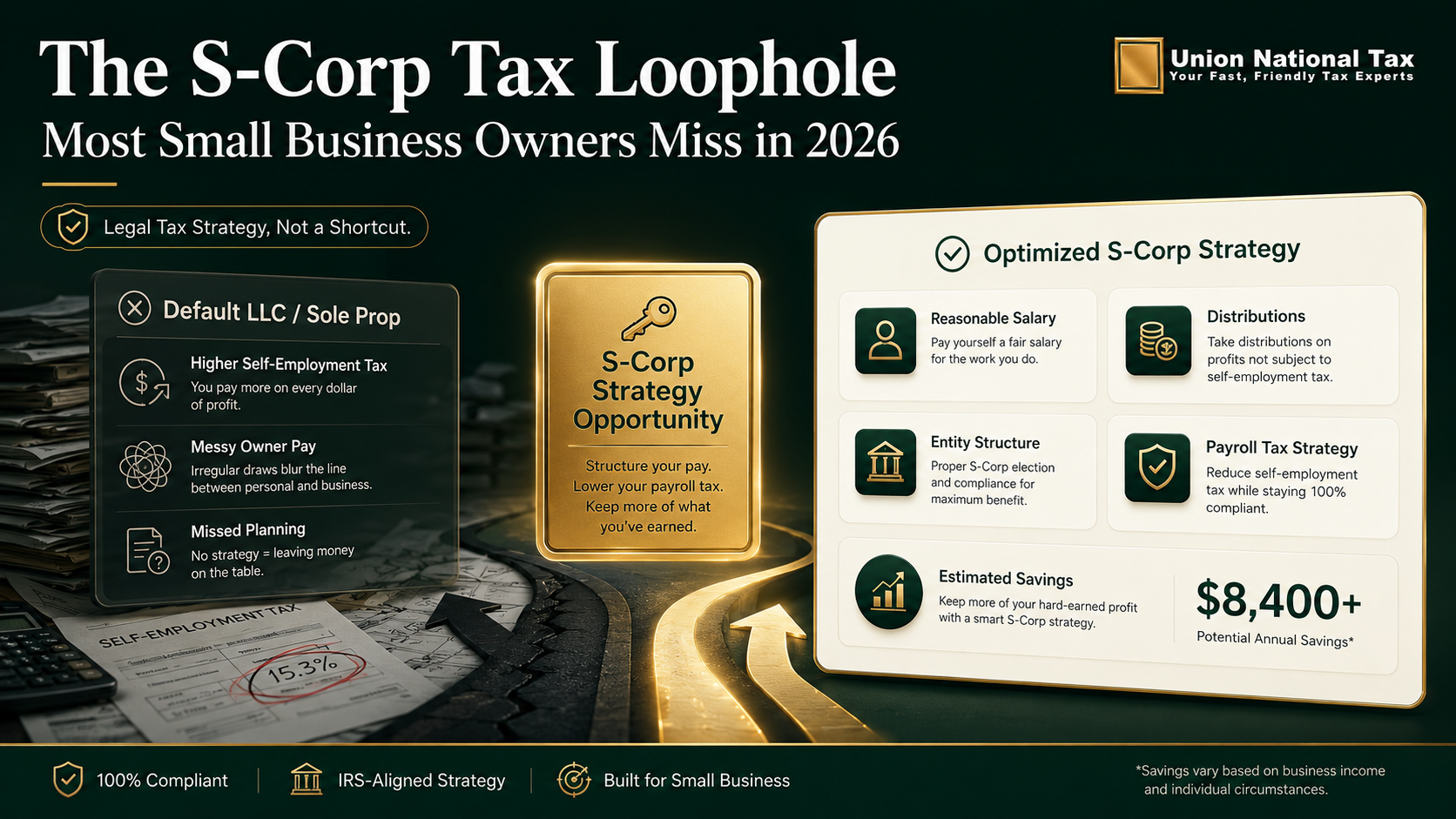
You're doing everything right. You're tracking expenses, maxing out your retirement contributions, and setting aside money for quarterly payments. And yet, every April, you feel the same sting: a tax bill that's higher than it should be.
The problem isn't your deductions. The problem is your business structure.
What Most Accountants Won't Tell You
When you're operating as a sole proprietor or single-member LLC, every dollar your business earns is subject to self-employment tax — that's 15.3% on top of your income tax. On $150,000 in net profit, that's roughly $22,950 going to self-employment tax alone.
An S-Corp election changes the math. Once you make the election, you can pay yourself a reasonable salary — say $60,000 — and take the remaining $90,000 as a distribution, which is not subject to self-employment tax.
That distribution portion? Gone. Tax-free. Legally.
The Numbers Don't Lie
Here's a side-by-side comparison for a business earning $150,000 in net profit:
Sole Proprietor / LLC vs. S-Corp Election:
Net Profit: $150,000 vs. $150,000
Self-Employment Tax: $22,950 vs. $9,180
Annual Savings: $13,770
Even after accounting for the cost of payroll processing (often $500–$1,000/year), the net benefit is $8,000–$13,000 in your pocket — every year, not just once.
Is an S-Corp Right for You?
The S-Corp election makes the most sense when:
Your business net profit exceeds $40,000/year
You have clients or contracts outside your employer
You're already paying self-employment tax on freelance or side income
You want a clearer separation between personal and business finances
It's not a fit for everyone — if your profit is too low, the compliance costs may outweigh the benefit. But for most established freelancers, consultants, and small business owners, the numbers work in your favor.
When to Make the Election
You can make the S-Corp election anytime — but timing matters. The election is made by filing Form 2553 with the IRS. For it to apply to the current tax year, you typically need to file it by the 15th day of the 3rd month of your tax year (March 15 for calendar-year filers).
Miss that window? You can still file it — it'll just apply to the next tax year. Either way, the sooner you make the election, the sooner you start saving.
How We Help Business Owners Navigate This
At Union National Tax, we've helped hundreds of small business owners evaluate whether an S-Corp election makes sense for their situation — and walked them through the entire process, from the IRS filing to setting up payroll correctly.
Jason Astwood, our Founder & Lead Tax Strategist, has personally overseen hundreds of S-Corp elections. He's a Certified Public Accountant and Enrolled Agent with over a decade of experience helping business owners legally reduce their tax burden.
Not sure if you qualify? Schedule a free 30-minute consultation. We'll review your business structure, run the numbers, and give you a straight answer — no pressure, no obligation.
Frequently Asked Questions
Does an S-Corp election require me to run payroll?
Yes. S-Corps must pay their owner-employees a reasonable salary, which requires payroll. This is a real cost but is typically far outweighed by the self-employment tax savings.
What's a "reasonable salary" for an S-Corp?
The IRS doesn't set a fixed minimum, but it must be reasonable for the services you perform. Our team helps clients determine a defensible salary based on industry standards and their specific role.
Can I switch back to LLC or sole proprietorship later?
Yes. The S-Corp election is made annually. You can revoke it in a future year if your situation changes — for example, if your income drops significantly or you no longer need the tax benefit.
Does an S-Corp help with estimated tax payments?
It can reduce the amount you owe each quarter. Since distributions are not subject to self-employment tax, your required estimated payments may be lower than they were as a sole proprietor.
What's the deadline to file Form 2553?
For calendar-year businesses, the deadline is March 15. For fiscal-year businesses, it's the 15th day of the 3th month of your fiscal year. Late filings are treated as applying to the following tax year.