
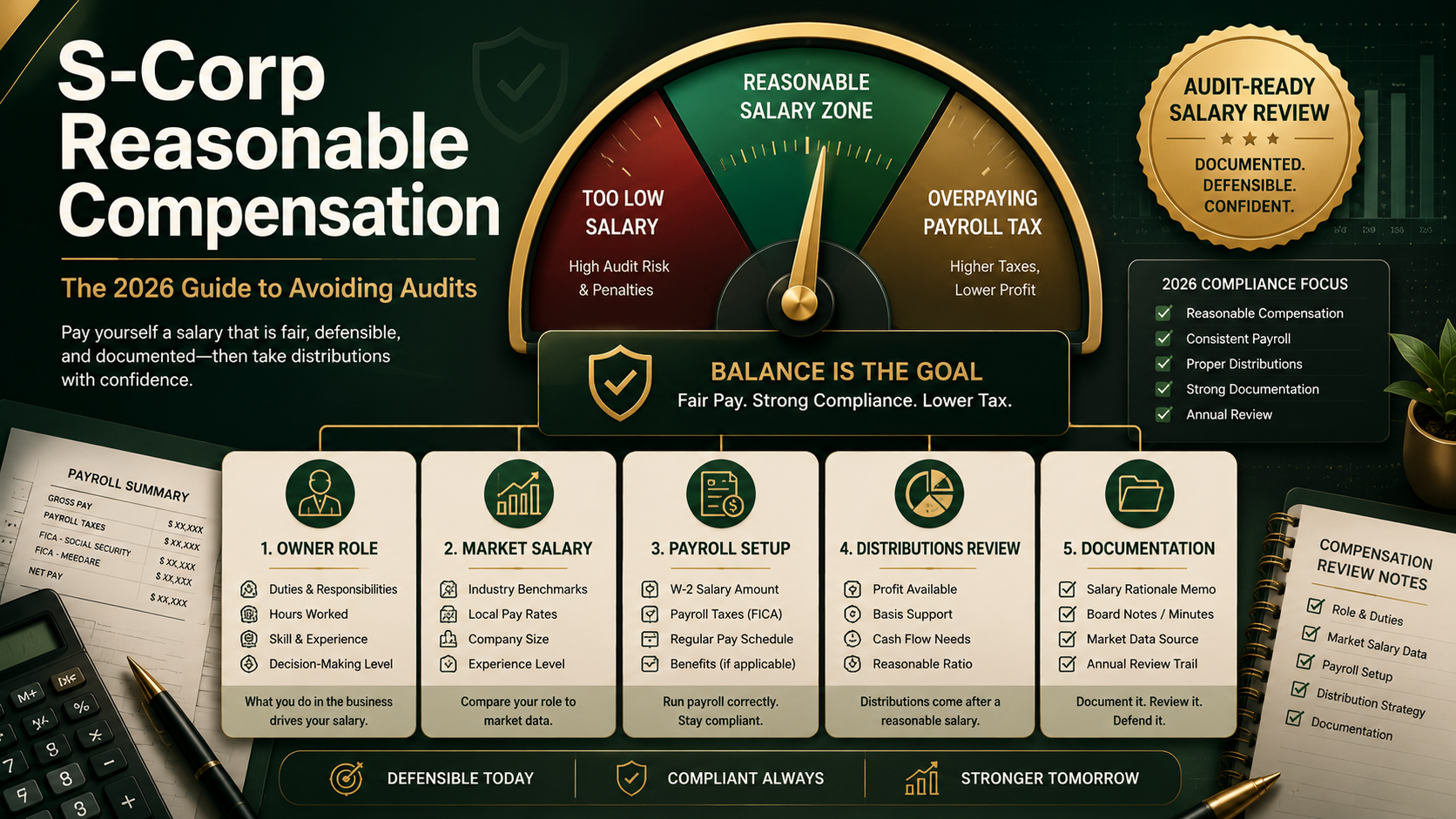
S-Corp Reasonable Compensation: The 2026 Guide to Avoiding Audits
The single most scrutinized aspect of an S-Corp by the IRS is "Reasonable Compensation." Because the IRS loses out on self-employment tax for every dollar you take as a distribution rather than a salary, they have a vested interest in ensuring your salary isn't too low.
In 2026, the IRS is using more advanced data analytics to flag business owners whose salaries look suspiciously low compared to their industry and revenue.
How to Define "Reasonable"
It isn’t a "rule of thumb" or a flat 50/50 split. The IRS looks at:
- **Your Duties:** Do you sweep the floors or negotiate million-dollar contracts?
- **Time Spent:** Is this a side hustle (5 hrs/week) or full-time (60 hrs/week)?
- **Market Data:** What would it cost to hire someone else to do your job?
The "RCReports" Defense
We don't guess. We use advanced compensation data (using software like RCReports) to create a defensible "Reasonable Compensation Study" for our clients.
This document acts as your "audit insurance," proving that your salary is backed by real-world market data, not just a number you pulled out of thin air to save taxes.
The Consequence of Getting It Wrong
If the IRS reclassifies your distributions as wages:
1. You owe back taxes (FICA) on that money.
2. You owe penalties for late payroll filing.
3. You owe interest on the underpayment.
Protect your S-Corp. Don't just pick a salary. Let us build a defensible compensation strategy for you.