
If you're running a profitable business as a sole proprietor or LLC, you're likely overpaying in self-employment taxes. The self-employment tax rate is 15.3% on net earnings—and that's on top of your income tax. For high-earning consultants, contractors, and business owners, this can mean tens of thousands of dollars in unnecessary tax burden every single year.
The S-Corp election exists as one of the most powerful legal tax-saving strategies available to small business owners. Yet most entrepreneurs don't know about it, or they don't understand how to use it correctly.
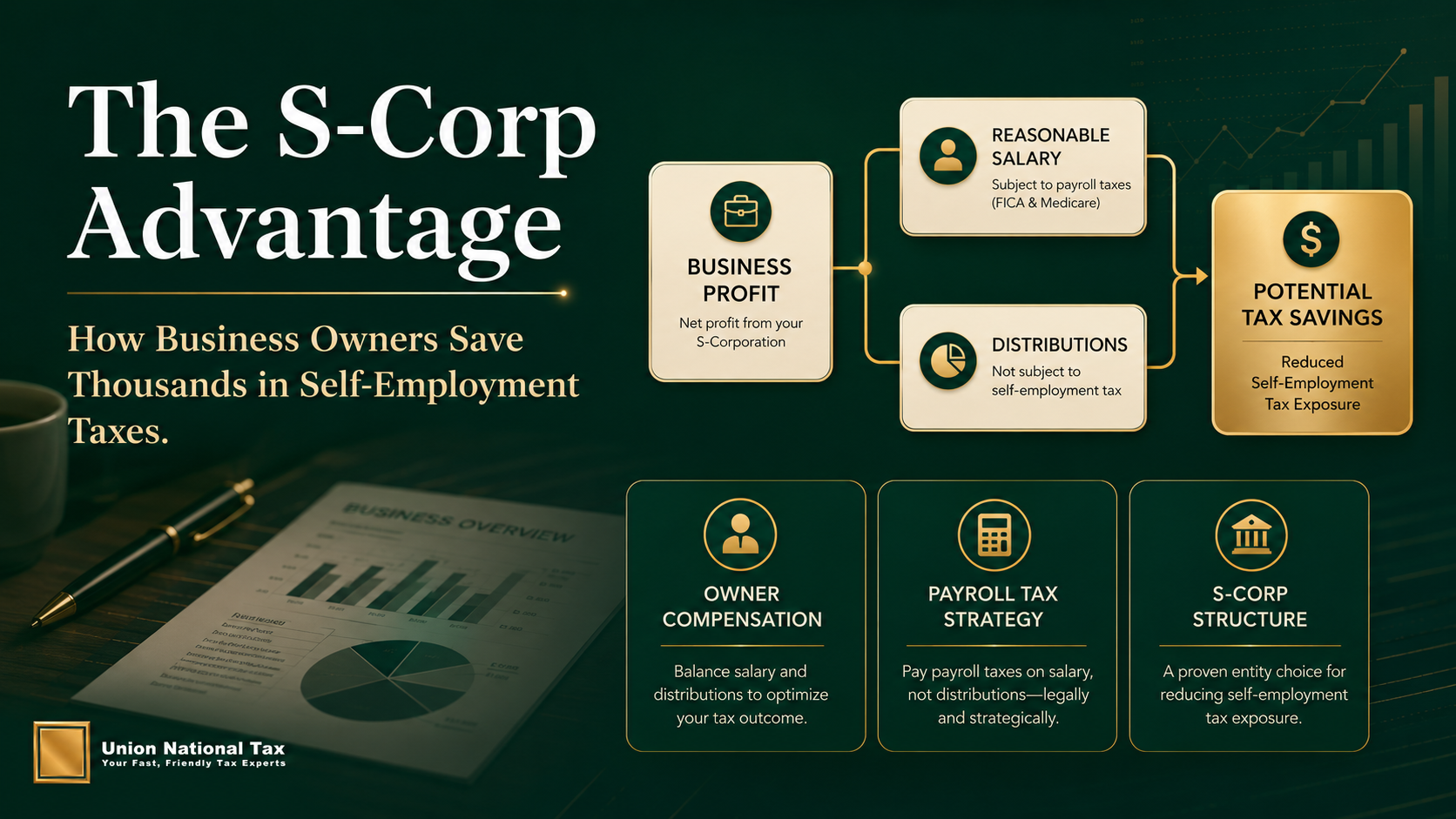
Here's the basic concept: When you operate as a sole proprietor or single-member LLC, all the profit from your business flows directly to your personal tax return and is subject to self-employment tax. But when you elect S-Corp status, you can split your business income into two parts—a reasonable salary (subject to payroll taxes) and distributions (NOT subject to payroll taxes). The distributions flow through to your personal return but escape the 15.3% self-employment tax entirely.
Let's look at a real example. Say you're a consultant earning $200,000 per year in net profit. As a sole proprietor, you'd pay self-employment tax on the full $200,000—that's $30,600 in self-employment tax alone, before income tax.
Now let's say you make an S-Corp election and pay yourself a reasonable salary of $100,000. The remaining $100,000 comes to you as distributions. Your self-employment tax is now only $15,300—a savings of $15,300 compared to the sole proprietorship structure.
That's real money. That's a significant reduction in your tax burden, completely legally, by simply changing how your business is classified.
Who qualifies for S-Corp election? Any eligible domestic corporation can elect S-Corp status by filing Form 2553 with the IRS. Eligibility requirements include having fewer than 100 shareholders, having only one class of stock, and being organized in the United States. Most importantly, you must be a U.S. citizen or resident alien.
The timing matters. You can generally elect S-Corp status to take effect for the current tax year if you file Form 2553 by the 15th day of the 3rd month of your tax year (March 15 for calendar-year taxpayers). Late elections can sometimes be accepted, but it's cleaner to plan ahead.
What about the added complexity? Yes, S-Corps require more administration. You need to run payroll, file quarterly payroll tax returns, and maintain corporate minutes. But for most profitable business owners, the tax savings far outweigh the added compliance costs. When you're saving $10,000, $20,000, or even $50,000 per year in taxes, paying a CPA a few thousand dollars extra to handle the compliance is still a net win.
The key is ensuring your salary is "reasonable" in the eyes of the IRS. They want to see that you're paying yourself a fair market rate for the work you perform in your business. If your salary is suspiciously low compared to industry standards, the IRS may reclassify some of your distributions as salary, negating the tax benefit.
Working with a tax professional who understands S-Corp elections is essential. The rules around reasonable compensation are nuanced, and the IRS scrutinizes S-Corp elections more closely than many other tax strategies.
If you're a business owner earning over $80,000 in net profit annually and you're currently operating as a sole proprietorship or single-member LLC, an S-Corp election could be one of the most impactful financial decisions you make this year. The potential tax savings are substantial, and the compliance requirements, while real, are manageable with proper planning.