
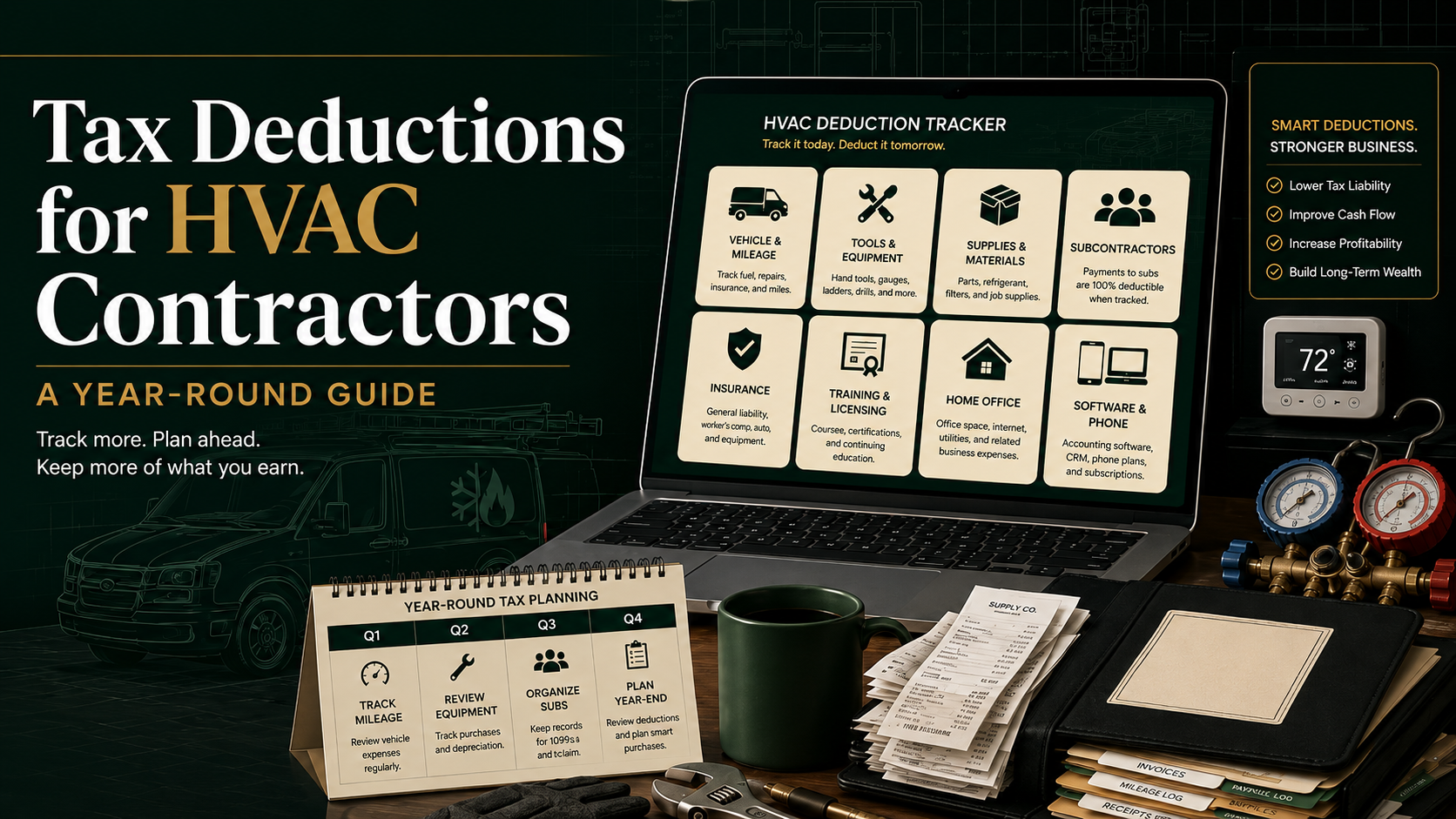
Tax Deductions for HVAC Contractors: A Year-Round Guide
Most HVAC contractors think about taxes in April. That's the first mistake.
The tax code rewards year-round behavior — not last-minute scrambles. By the time Q1 rolls around, receipts are scattered, mileage logs are incomplete, and deductions have quietly expired. This guide covers every deduction available to HVAC contractors across the full calendar year, with specifics on what qualifies, what documentation you need, and when to act.
1. Equipment and Tool Purchases
HVAC work runs on tools—and the IRS lets you deduct them fully in the year you buy them.
Under Section 179, you can expense the full cost of qualifying equipment rather than depreciating it over time. No waiting. No partial deductions spread across five years.
What qualifies:
- Refrigerant recovery machines
- Brazing outfits and welding equipment
- Diagnostic instruments (combustion analyzers, manifold gauges, thermal imagers)
- Hand tools used exclusively on the job
- Replacement equipment when old units are retired
"⚠️ Key rule: The equipment must be used for business at least 51% of the time. Personal-use items don't qualify."
Timing tip: Don't wait until December. If you know you'll need a new recovery unit or leak detector in Q1 of next year, buy it before December 31 and deduct it this year.
2. Vehicle Expenses
Your service van is one of the most powerful deductions available to HVAC contractors — if you track it properly.
You have two options for deducting vehicle costs:
Method
How It Works
Best For
Standard Mileage Rate
Multiply business miles by the IRS per-mile rate
Simple, minimal record-keeping
Actual Expense Method
Track fuel, oil, tires, insurance, repairs—then apply the business-use %.
High-use vehicles, usually yields more
Do the math both ways every year. For HVAC contractors driving 30,000+ business miles annually, actual expenses often win.
"💡 Pro tip: Use a GPS mileage tracker app. The cost is deductible, and it eliminates the risk of incomplete logs if you're ever audited."
3. Business Operating Expenses
The day-to-day costs of running your HVAC business are deductible—and most contractors underreport them.
What you can deduct:
- Rent or lease payments for a shop, warehouse, or storage unit
- Utilities (pro-rated if home-based)
- General liability, workers' comp, and commercial auto insurance premiums
- Professional licenses and permits (contractor licenses, EPA Section 608 certification fees)
- Field service management software, invoicing tools, and QuickBooks subscriptions
- Advertising and marketing (website hosting, business cards, local ads, Google Ads)
- Cell phone (business-use percentage)
Set a quarterly calendar reminder to review and categorize your operating expenses. Waiting until April means forgotten receipts and missed deductions.
4. Training and Certifications
The HVAC industry requires ongoing education—and the IRS allows deductions for any training that maintains or improves skills required in your current trade.
What qualifies:
- EPA 608 Universal certification renewal
- NATE certification exams and prep courses
- Manufacturer-specific training on new equipment systems
- OSHA 10 or 30-hour safety training
- State contractor license continuing education requirements
"⚠️ Important distinction: Education that qualifies you for a new trade or business does NOT qualify — that's treated as a capital expense. Training that keeps you current in HVAC does."
5. Health Insurance Premiums
If you're self-employed and not eligible for employer-sponsored coverage, you can deduct 100% of health insurance premiums for yourself, a spouse, and dependents.
This is an above-the-line deduction taken on Form 1040—not on Schedule C—which means it reduces your adjusted gross income regardless of whether you itemize.
6. Retirement Contributions
Contributing to a retirement account is one of the most powerful deductions available to self-employed contractors—and it builds wealth at the same time.
Your options in 2026:
Account
Contribution Limit
Best For
SEP-IRA
Up to 25% of net SE income (~$66,000 max)
Solo operators, simple setup
Solo 401(k)
Higher combined limit, Roth option available
Higher earners who want flexibility
SIMPLE IRA
Lower limits, employer match required
HVAC businesses with employees
Contributions made before your tax filing deadline (including extensions) count for the prior tax year. This means you can reduce your 2026 tax bill as late as October 2027 if you file on extension.
7. Year-Round Estimated Tax Payments
HVAC contractors expecting to owe $1,000 or more in taxes should make quarterly estimated payments—both federal and state. Skipping them triggers underpayment penalties even if you pay in full at year-end.
2026 Quarterly Deadlines:
- Q1 → April 15
- Q2 → June 15
- Q3 → September 15
- Q4 → January 15, 2027
"💡 Best practice: Open a dedicated savings account and deposit 25–30% of every job payment the same day you receive it. When the quarterly bill comes, the money is already there."
HVAC Tax Deductions Checklist
Use this before filing to make sure nothing slips through:
- Section 179 equipment and tools purchased before Dec 31
- Mileage log or actual vehicle expense records for the full year
- Business operating expenses categorized (insurance, software, licenses, marketing)
- Training and certification receipts saved and categorized
- Health insurance premium total documented
- Retirement contributions made before the filing deadline
- Quarterly estimated taxes paid on time (no underpayment penalty)
- Home office measurements, documented if applicable
FAQ — HVAC Contractor Tax Deductions
Can I deduct tools I buy at a hardware store?
Yes—if the tools are used exclusively for your HVAC business. Tools under $2,500 per item can often be expensed immediately under the de minimis safe harbor.
Can I deduct home office expenses?
Yes, if you have a dedicated space used exclusively for business. Use the simplified method ($5/sq ft, up to 300 sq ft) or the regular method (actual expenses × business-use percentage).
Can I deduct my family's health insurance premiums?
Yes. Self-employed individuals deduct 100% of health insurance premiums for themselves, a spouse, and dependents as an adjustment to income on Form 1040—above the line.
What records do I need to keep?
Receipts for all deductible expenses, daily mileage logs, bank and credit card statements, and home office measurements — for a minimum of 3 years.
Stop Leaving Money Behind
HVAC contractors who stay organized year-round consistently recover thousands more than those who scramble in April.
Union National Tax specializes in tax strategy for trades and contractors. We know exactly which deductions apply to your business—and how to structure your books so nothing slips through.
👉 Schedule a free consultation to review your deductions before year-end.