
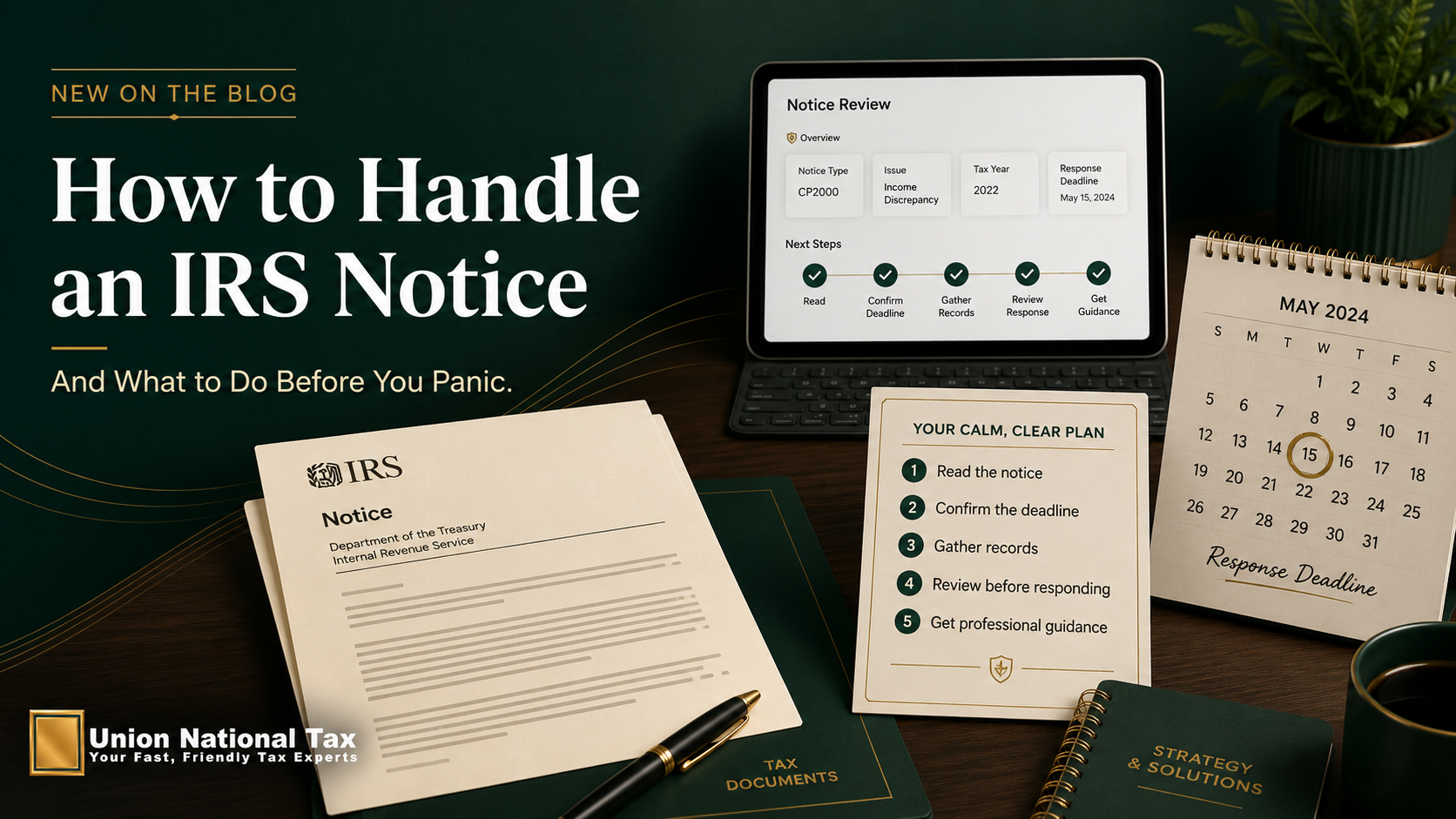
Getting a letter from the IRS is one of the most anxiety-inducing experiences for any business owner or individual taxpayer. The envelope looks official. The language is intimidating. And if you don't fully understand what they're asking, it's easy to either ignore it or panic.
Neither reaction is correct.
Here's the truth: most IRS notices are routine. They're asking for information, pointing out a discrepancy, or informing you of a change to your account. That doesn't mean they're harmless — missed deadlines or mishandled notices can escalate quickly — but it does mean you have time to respond intelligently.
This guide walks you through exactly what to do in the first 48 hours of receiving an IRS notice, how to decode what you're reading, and when to bring in a tax resolution professional.
Step 1: Read It Completely — Twice
Before you call anyone, read the notice fully. Read it again. IRS notices always include: the tax year at issue, the specific amount owed (or refund adjusted), and what caused the change. Look for the "Reason for Notice" section — it's usually in the first paragraph.
Common notice types include: CP14 (balance due), CP501 (reminder), CP503 (urgent), LT39 (intent to levy), CP90 (final notice of intent to levy). The number matters. A CP14 is a billing notice. An LT39 means the IRS is actively preparing to seize assets. Know where you stand.
Step 2: Don't Ignore It — But Also Don't Overreact
Many taxpayers make the mistake of either ignoring the notice or paying immediately without investigating. Both can be costly.
If you ignore it: the IRS will follow up, and penalties and interest will compound daily. A balance due of $5,000 today could be $6,200 in six months due to penalties and interest.
If you pay without reviewing: you may be paying for something you don't actually owe. IRS notices frequently contain errors — missing credits, miscalculated penalties, wrong tax year.
Step 3: Verify the Numbers
Pull your records for the tax year in question. Compare the IRS's figures against your filed return. Check your W-2s, 1099s, and any deduction documentation you have.
If the notice says you owe $8,400 and your return showed $0 balance due, something is wrong. This happens more often than you'd think — especially with math errors on the IRS's end or mismatched 1099s.
Step 4: Know Your Response Options
If you agree with the notice: Pay the amount due. You can pay online at irs.gov/payments or mail a check with the payment voucher at the bottom of the notice.
If you disagree: You have the right to contest. File a written protest within the timeframe shown on the notice (usually 30-60 days). Include your reasoning and any supporting documentation. This is where a tax resolution professional earns their fee.
Step 5: Call a Tax Resolution Pro for These Specific Notices
You should immediately contact a tax resolution professional — not a general CPA — if your notice includes any of these phrases: "Final Notice of Intent to Levy," "Seizure," "Offer in Compromise," "Installment Agreement," or "Mathematical Error."
These notices require strategic response, not just payment. A tax resolution attorney or enrolled agent can negotiate with the IRS on your behalf, request penalty abatement, set up an installment agreement, or explore an offer in compromise.
The Bottom Line
An IRS notice is not the end of the road. It's a request for information or a billing statement. Handle it calmly, verify the numbers, and respond within the deadline. And when the notice involves potential levy or legal action, get a qualified tax resolution professional involved before you make any decisions.