
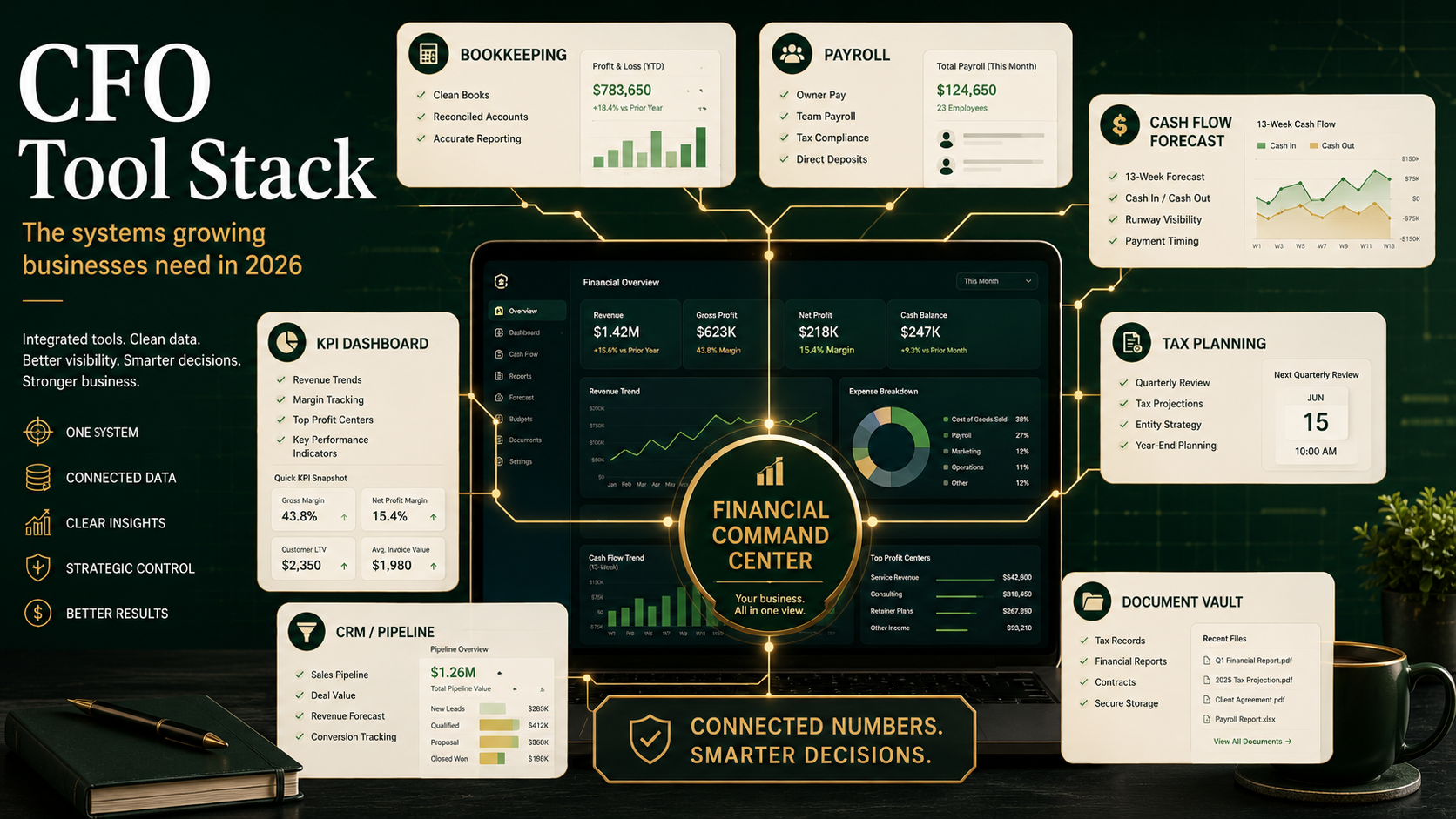
The CFO Tool Stack Every Growing Business Needs in 2026
Ask most business owners what their financial infrastructure looks like and you'll get the same answer: "We use QuickBooks."
That's not a financial infrastructure—that's a transaction recorder. And it's the reason most growing businesses make financial decisions based on last month's data, gut feel, and periodic panic.
For businesses between $500K and $10M in revenue, the CFO function doesn't need to be a single person. It needs to be a system. Here's what that system looks like, layer by layer.
Why Most Businesses Don't Have Real Financial Visibility
The problem isn't that business owners don't care about their finances. It's that they were never given a framework for what a proper financial infrastructure looks like.
A bookkeeper who records transactions is not a CFO function. An accountant who files your taxes once a year is not a CFO function. A CFO function gives you:
- Real-time view of your financial position
- Forward-looking cash flow projections
- Margin analysis by client, project, or product line
- Proactive tax planning—not year-end reactions
- Strategic financial input into business decisions
The tools below build this function — even if you don't have a full-time CFO on staff.
Layer 1: Core Accounting (The Foundation)
Tools: QuickBooks Online, Xero
Every other layer in this stack depends on this one. Clean, reconciled books, accurate within a few days of real time — that's the non-negotiable baseline.
If your bookkeeper is doing data entry but not reconciling, you have a record-keeping service, not a financial foundation. The distinction matters because everything downstream—reporting, forecasting, tax planning, and investor-ready financials—is built on this layer.
"⚠️ Red flag: If you can't pull an accurate P&L for last month on demand, your foundation needs work before any other tool matters."
Layer 2: Integrated Payroll
Tools: Gusto, Rippling, ADP (for larger teams)
Payroll should not be siloed. When your payroll system integrates directly with your accounting software, labor costs flow automatically into your P&L—giving you real-time labor margin visibility instead of a monthly catch-up.
Why this matters for CFO work:
- Labor is typically your largest expense category
- Benefits ratio and comp benchmarks are only visible when payroll feeds your P&L
- Gusto's QuickBooks/Xero sync handles this automatically for most small teams
Layer 3: Cash Flow Management
Tools: Float, Agicap, Pulse
This is where most businesses fall short. They have accounting (a historical view) but no cash flow management (a forward view). These are two completely different things.
A 13-week rolling cash flow forecast tells you:
- When you're going to hit a cash crunch—before it happens
- How much runway you have for a new hire or equipment purchase
- Whether you can fund your next quarterly estimated tax payment without stress
For businesses with uneven revenue—agencies, contractors, and project-based service firms—a cash flow tool is not optional. It's the difference between planning and reacting.
Layer 4: Job Costing and Project Tracking
Tools: Harvest, Function, Bill.com (for service businesses); Buildertrend, CoConstruct (for construction and trades)
If you bill by project, hour, or milestone, you need job costing that feeds into your financial reporting. Without it, you can't answer the most important financial question in any service business:
""Which of our clients or projects are actually profitable?""
The goal is to know, at any moment, what each project's actual margin is—not the estimated margin from the proposal you wrote six months ago.
Layer 5: Tax Optimization Infrastructure
Tools: Dedicated tax reserve account, quarterly estimated tax calendar, tax projection tool
This is the layer most businesses skip entirely—and it's the one that causes the most pain.
The two-step setup that eliminates 90% of tax surprises:
- Open a separate business savings account labeled "Tax Reserve."
- Auto-transfer 25–30% of every payment received into it the same day
That's it. This takes 15 minutes to configure and permanently eliminates the most common cash flow crisis we see in growing businesses — the one where a $40K quarterly estimated tax bill arrives and the money is already spent.
"💡 Bonus: Your fractional CFO or tax advisor should be running a tax projection mid-year (June/July) so you can make strategic decisions — retirement contributions, equipment purchases, entity structure — before December 31."
Layer 6: Financial Dashboard and Reporting
Tools: LiveFlow, Fathom, Jirav, or a well-built Google Sheets dashboard synced to QuickBooks
QuickBooks provides financial statements—but they're designed for accountants, not operators. A CFO dashboard translates your financial data into decisions.
Your monthly dashboard should show:
- Gross margin by client, project, or revenue line
- Revenue vs. prior year (same month)
- Current cash runway (weeks)
- AR aging (what's overdue and by how much)
- Tax reserve balance vs. projected quarterly liability
- Key KPIs relevant to your business model
Someone—your fractional CFO, internal finance lead, or senior advisor—should review this dashboard with you monthly, not quarterly.
The Human Layer: Who Owns the System
Role: Fractional CFO (8–15 hours/month for businesses under $5M)
Tools don't replace judgment. Every business needs someone in the financial seat who can look at the data and ask, "What are we not seeing? What decision does this suggest?"
For most growing businesses, a fractional CFO is the right human layer on top of this tool stack. They run the monthly review, model financial scenarios, and provide the strategic input that turns data into decisions—without the $200K+ cost of a full-time hire.
The investment in a proper CFO tool stack plus fractional oversight typically runs $1,500–$4,000/month — a fraction of the financial surprises, missed deductions, and cash crises it prevents.
CFO Tool Stack by Business Stage
Revenue Stage
Core Accounting
Payroll
Cash Flow
Dashboard
Human Layer
Under $500K
QuickBooks Simple
Gusto
Pulse or spreadsheet
Basic QBO reports
Monthly bookkeeper
$500K–$2M
QuickBooks Online
Gusto + QBO sync
Float or Agicap
LiveFlow or Fathom
Fractional CFO (part-time)
$2M–$10M
QuickBooks Online or Xero
Rippling or Gusto
Agicap or Jirav
Custom dashboard
Fractional CFO (ongoing)
$10M+
NetSuite or Sage Intacct
ADP or Paylocity
Built-in forecasting
CFO-grade BI tool
Full-time CFO
CFO Tool Stack Checklist
Before your next fiscal year, confirm you have each layer in place:
- Books are reconciled within 5 business days of real time
- Payroll integrates directly into your accounting software
- You have a 13-week cash flow forecast updated weekly
- Job costing is tracked at the project/client level (if applicable)
- The tax reserve account is funded at 25–30% of revenue
- The mid-year tax projection is scheduled (June or July.
- The monthly financial dashboard is being reviewed with a CFO or advisor
- You know your gross margin, cash runway, and AR aging without having to ask
FAQ — CFO Tool Stack for Growing Businesses
How much does a CFO tool stack cost?
The tools themselves typically run $300–$800/month depending on team size and which layers you implement. Add a fractional CFO at $1,500–$3,500/month, and the total investment for a complete system is usually under $5,000/month—far less than a full-time hire and significantly less than the cost of financial blind spots.
Do I need all six layers?
Not necessarily from day one. Start with Layer 1 (accounting) and Layer 5 (tax reserve)—those two alone eliminate the most common pain points. Add layers as revenue grows and financial complexity increases.
What's the difference between a bookkeeper and a CFO?
A bookkeeper records what happened. A CFO analyzes what it means, projects what's coming, and advises on what to do about it. Most growing businesses need both—they're not interchangeable roles.
Can I use a fractional CFO instead of building this tool stack?
A fractional CFO will usually build this stack for you as part of their engagement. It's not either/or—the tools give the CFO the data they need to do their job. Without the tools, even the best fractional CFO is operating with limited visibility.
Build the System Before You Need It
The businesses that scale smoothly are not the ones with the best products or the most aggressive sales teams. They're the ones who built financial infrastructure before they needed it.
A proper CFO tool stack gives you the visibility to see problems coming, the data to make confident decisions, and the systems to scale without financial chaos.
Union National Tax helps growing businesses build and operate the financial infrastructure they need—bookkeeping, tax strategy, cash flow planning, and fractional CFO services under one roof.
👉 Schedule a free consultation to review your current financial stack.